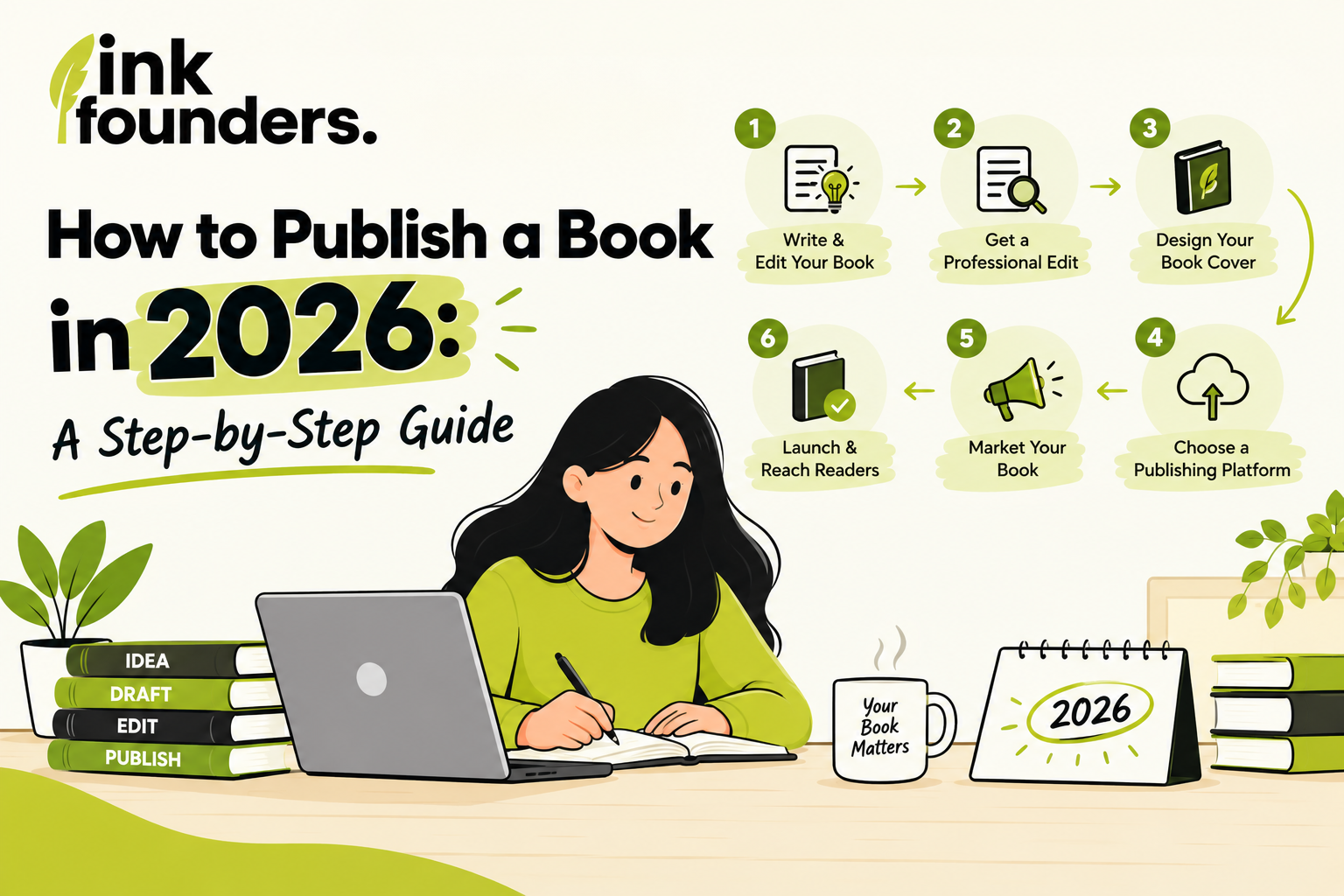
Quick Answer: To publish a book in 2026, start by completing your manuscript, editing your content, choosing a publishing method, and preparing your book cover and formatting. Next, handle your ISBN, pricing, and distribution, then launch your book and promote it to reach your target audience. If you need professional help with book publishing, formatting, cover design, or self-publishing, InkFounders.com can help you turn your manuscript into a professionally published book.
Have your own book published, there are a variety of different options available to you. The choices include contracting a traditional publisher, self-publishing the book independently, or hiring an experienced publishing service. The best choice for you will depend on the amount of control you want over the process, together with your budget, goals, and timeline.
At Ink Founders, writers have the opportunity to look for assistance regarding writing, editing, design of books, typesetting, publishing, and marketing. Knowing how the publishing works will enable the author to make wiser decisions, whether he/she already has a complete manuscript or is just at an idea stage.
This manual will teach you about the processes required to publish a book, including how to self-publish one, locate a publisher, and things to think about before publishing.
How to Publish a Book in 7 Steps
To publish a book, follow these seven steps:
- Finish writing your manuscript.
- Edit and proofread your book.
- Choose a publishing method.
- Design your book cover and format the pages.
- Prepare your ISBN and publishing details.
- Publish and distribute your book.
- Promote your book to reach readers.
Each step helps prepare your book for publication and gives it a better chance of making a positive impression on readers.
Step 1: Finish Writing Your Book
Before you publish a book, you need a complete manuscript. Your manuscript is the written content that will become your finished book.
Start by deciding what your book is about and who will read it. A clear purpose helps you organize your ideas and create content that meets readers’ needs.
Follow these steps to prepare your manuscript:
- Choose a clear topic or story idea.
- Identify your target audience.
- Create a book outline with chapters.
- Set a realistic writing schedule.
- Complete the first draft.
- Review the draft for missing information and weak sections.
If you are writing nonfiction, organize your ideas into logical chapters. For fiction, focus on the plot, characters, setting, and story development.
How to Write a Book If You Are a Beginner
You do not need to write a perfect first draft. Focus on completing your ideas before spending too much time correcting individual sentences.
Set a daily or weekly writing goal that fits your schedule. Even small writing sessions can help you make steady progress.
If you have a strong idea but need help developing it, professional book writing and ghostwriting services can help you turn your concept into a structured manuscript.
Step 2: Edit and Proofread Your Manuscript
Once your first draft is complete, the next step is editing. A finished draft may contain unclear sentences, repeated ideas, grammar mistakes, or gaps in the content.
Editing helps improve the structure, clarity, and overall quality of your book.
There are three common types of editing:
- Developmental editing: Improves the book’s structure, ideas, plot, and chapter organization.
- Copyediting: Checks grammar, spelling, sentence clarity, consistency, and word usage.
- Proofreading: Checks the final version for typographical errors and remaining mistakes.
The type of editing you need depends on your manuscript’s condition. Some books need major structural changes, while others only need light editing and proofreading.
Before moving to design, review the edited manuscript carefully. Confirm that the text reflects your intended message and that all important changes have been approved.
professional editing and proofreading services if you want help preparing your manuscript for publication.
Step 3: Choose the Right Publishing Method
One of the most important decisions is choosing how you want to publish your book. Different publishing methods offer different levels of control, support, cost, and responsibility.
| Publishing method | How it works | Best for |
|---|---|---|
| Traditional publishing | A publishing house selects a manuscript and publishes it under an agreed contract. | Authors seeking a publisher’s editorial and publishing support |
| Self-publishing | The author manages publication directly or hires individual service providers. | Authors seeking a publisher’s editorial and publishing support |
| Assisted publishing | The author pays a service provider for selected publishing tasks or a package. | Authors who want professional help with production |
| Hybrid publishing | A publisher and author share responsibilities under a defined publishing agreement. | Authors considering a collaborative publishing arrangement |
| Hybrid publishing | A publisher and author share responsibilities under a defined publishing agreement. | Authors considering a collaborative publishing arrangement. |
The exact terms, costs, rights, and responsibilities vary by company and contract. Always review these details before making a decision.
Traditional Publishing vs. Self-Publishing
Traditional publishing often requires authors to research suitable publishers, prepare submission materials, and wait for a decision. Acceptance is not guaranteed.
Self-publishing gives authors more control over their publication decisions. However, authors must manage or arrange editing, design, distribution, marketing, and other production tasks.
Before choosing a method, ask yourself:
- Do I want to manage the publishing process myself?
- Can I pay for professional services if needed?
- How important are creative control and publishing rights?
- Do I need help with editing, design, or marketing?
- Which formats do I want to publish: ebook, paperback, or hardcover?
If you want professional help with different stages of publication and compare the available options with your needs.
Step 4: Design Your Book Cover and Format the Pages
Your book needs a professional presentation before it is published. This includes the cover, interior layout, and correct file formats.
Create a Book Cover
Your cover should reflect the book’s subject, genre, and intended readers. A romance novel, business book, children’s book, and thriller usually need different visual styles.
A good cover should have:
- A clear and readable title.
- Appropriate typography.
- Images or artwork that fit the book.
- A design that works at thumbnail size.
- The correct dimensions for your publishing format.
You can explore professional book cover design services if you need a custom cover for your manuscript.
Formatting a Book
In printing, formatting consists of page size, margins, chapter headings, page numbers, and spacing. In an ebook, the format must work on devices and different screens.
Before approval, make sure to check the page layout, chapter order, images, headings, and table of contents.
Step 5: Prepare Your ISBN and Publishing Details
Before publication, you may need to prepare an ISBN, copyright information, book description, author biography, and other metadata.
An ISBN is an International Standard Book Number used to identify a particular book edition and format in many book-trading systems.
Keep these points in mind:
- ISBN requirements vary by country and publishing platform.
- Different editions or formats may require separate ISBNs.
- Some publishing platforms offer free identifiers for eligible publications, but these may have limitations.
- Copyright protection and registration rules depend on the applicable law.
- Your title, author name, description, and category should be accurate.
Check the official ISBN agency for your country and the requirements of your chosen publishing platform before purchasing or registering an ISBN.
Do not assume that buying an ISBN automatically registers your copyright. These are separate matters.
Step 6: Publish and Distribute Your Book
After editing, design, and formatting are complete, prepare your final files for publication.
You can publish a book in several formats:
- Ebook: A digital book that readers access through compatible devices.
- Paperback: A printed book with a flexible cover.
- Hardcover: A printed book with a rigid cover.
You can choose one format or release several editions, depending on your audience and budget.
How to Publish a Book on Amazon
Amazon Kindle Direct Publishing (KDP) is one option for authors who want to publish eligible ebooks and print books.
The general process is:
- Create an account on the publishing platform.
- Enter your book title, author name, description, and other details.
- Upload the manuscript and cover files.
- Select the available publishing territories and rights.
- Review pricing, royalties, and other publishing settings.
- Preview the book and correct any errors.
- Submit it for publication and monitor its status.
Platform requirements can change, so review the latest official KDP instructions before uploading your book.
If you want to release a digital edition, explore ebook publishing services for help with formatting, publishing preparation, and distribution planning.
How to Publish a Book on Your Own
You can publish your own book without signing a traditional publishing contract. You will still need to prepare the manuscript, select a publishing platform, complete the required details, and manage the release.
You can handle every task yourself or hire professionals for specific parts of the process.
Self-publishing gives you more control, but it also means you must make informed decisions about quality, pricing, rights, distribution, and marketing.
Step 7: Promote Your Book After Publication
Publishing your book is only one part of the process. Readers also need ways to discover it.
Start with a practical marketing plan:
- Create an author website or a dedicated book page.
- Write a clear, engaging book description.
- Share relevant content on social media.
- Contact readers, communities, or organizations interested in your topic.
- Build an email list with permission from subscribers.
- Request honest reviews from readers.
- Consider book promotions and advertising when they fit your budget.
Choose promotional activities that match your audience. A business book may benefit from professional networks, while a children’s book may be more relevant to parents, educators, and libraries.
Avoid buying fake reviews or making claims about sales and popularity that you cannot support.
How Long Does It Take to Publish a Book?
The time required to publish a book depends on the manuscript, editing needs, design, publishing method, and distribution arrangements.
A self-published book with a finished manuscript and prepared files may be ready sooner than a book that still needs substantial writing and editing. Traditional publishing can take longer because of submission, acquisition, scheduling, and production stages.
|
Publishing stage |
What affects the timeline? |
| Writing | Book length, research, and available writing time |
| Editing | Manuscript quality and level of editing required |
| Cover design | Design complexity and revision rounds |
| Formatting | Book length, illustrations, and print or ebook requirements |
| Publishing setup | Metadata, file checks, and platform requirements |
| Distribution | Platform processing and release arrangements |
There is no single timeline that applies to every book. Ask your publisher or service provider for a realistic schedule based on your manuscript and chosen format.
How Much Does It Cost to Publish a Book?
The book editing services prices depends on the services you need and the choices you make.
Some authors manage most tasks themselves, while others pay professionals for writing, editing, design, formatting, publishing support, and marketing.
Your budget may include:
- Manuscript editing and proofreading.
- Book cover design.
- Interior formatting.
- ISBNs and other publishing requirements.
- Printing and shipping.
- Distribution-related expenses.
- Marketing and promotion.
The final cost also depends on the book’s length, genre, illustrations, number of formats, and production quality.
Before choosing a publishing package, request an itemized quote. Check what is included, what costs extra, who owns the copyright, and whether you retain control of your publishing accounts and files.
How Hard Is It to Get a Book Published?
Getting a book published can be challenging, but the difficulty depends on your chosen route.
Traditional publishers select manuscripts based on their publishing plans, audience, and commercial or editorial priorities. Authors may need to submit proposals or sample chapters and wait for a response.
Self-publishing removes the need to secure acceptance from a traditional publisher, but it does not remove the work required to prepare and market a good book.
To make the process easier:
- Finish and revise your manuscript.
- Research your target audience.
- Choose a suitable publishing method.
- Prepare professional files.
- Read contracts and platform requirements carefully.
- Set realistic expectations for sales and promotion.
A clear plan can help you avoid unnecessary costs and make better decisions at every stage.
How to Find a Publisher for Your Book
If you prefer traditional publishing, research publishers that work with your genre and type of manuscript.
Follow these steps:
- Identify publishers that accept your type of book.
- Read their submission guidelines.
- Prepare a book proposal if required.
- Write a professional query letter.
- Submit the requested sample chapters or manuscript.
- Track submissions and responses.
- Review any offer and contract carefully.
Some publishers accept unsolicited submissions, while others require authors to work through a literary agent. Requirements vary, so always check the publisher’s official website.
Be cautious of companies that promise guaranteed sales, guaranteed bestseller status, or publication in exchange for unclear fees. Understand whether a company is offering a traditional publishing contract or a paid service.
If you are not seeking a traditional publishing deal, you can also compare self-publishing and assisted publishing options.
How to Publish a Christian Book
Publishing a Christian book follows many of the same steps as publishing other books, but you should also consider your faith-based audience and the expectations of your genre.
First, decide whether your book is a devotional, Bible study, Christian fiction, testimony, ministry resource, or another type of Christian publication.
Then:
- Identify the readers you want to reach.
- Complete and edit your manuscript.
- Research Christian publishers that accept your genre.
- Check submission and theological review requirements where applicable.
- Prepare a cover and description that fit the intended audience.
- Choose traditional publishing or self-publishing.
- Plan distribution and promotion through relevant communities and channels.
If you choose a traditional Christian publisher, review its submission policy and statement of faith, if applicable. If you self-publish, you will have more direct control over your publishing decisions.
Need help with your book?